Not every disappointing dating site is a scam. But some are built around misleading profile activity, paid chat, buried disclosures and subscription tricks that can cost you far more than you expected.
This guide covers 21 warning signs to look for before you pay for a dating site, buy credits, share personal details or get emotionally invested in someone you have never met.
Want a more direct route to casual dating? Try WannaHookUp — my current top pick.
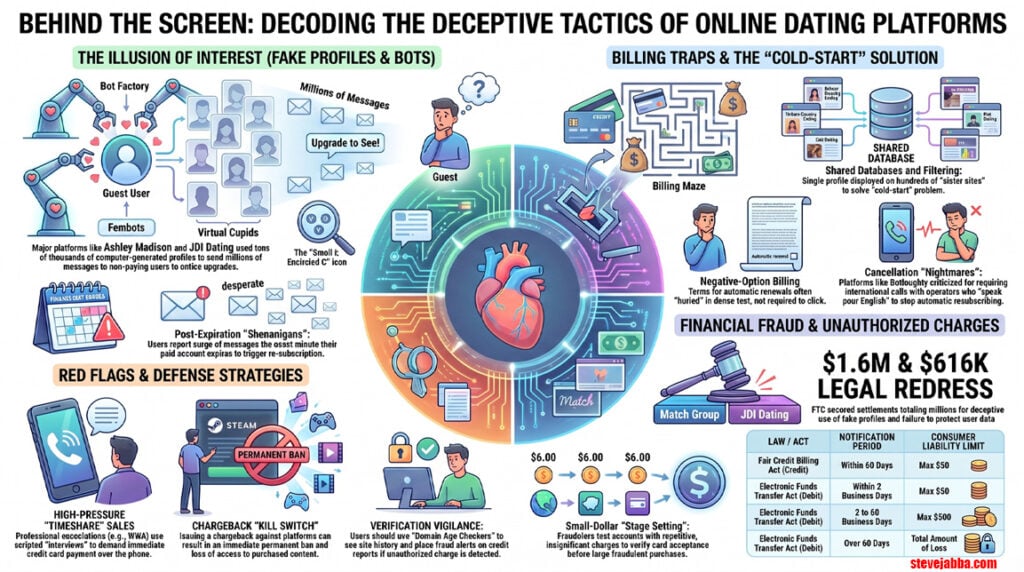
Want to share this infographic? Please credit SteveJabba.com as the original source.
Check a Dating Site Before You Pay
Want to look up a specific brand? Browse my dating site scam checks and reviews.
For more practical comparisons of dating platforms that are better suited to meeting real people, see my top dating and hookup apps guide.
Platform-Level Warning Signs
These are the signs that the dating site itself may not be built around helping people meet real partners.
1. You Get Generic Messages the Moment You Join
You sign up, have not uploaded a photo, have barely written a profile, and suddenly several attractive people are supposedly desperate to speak to you.
That does not automatically prove the site is fake. But it is a classic lure. Some platforms use instant likes, flirty prompts and generic messages to create the impression that the site is buzzing with activity before you have any realistic reason to stand out.
Look at the messages closely. Are they specific to anything on your profile? Do they read like a human being actually noticed you? Or are they vague lines that could have been sent to every new member?
2. The Terms Mention “Virtual,” “Entertainment” or “Fictitious” Profiles
This is one of the biggest things to check before spending a penny.
Some dating platforms disclose in their terms that certain profiles are virtual, illustrative, entertainment-based or operated for engagement purposes. That does not necessarily mean the site is breaking the law. It does mean you need to understand what you are paying for.
If your goal is to meet someone in real life, a site that relies heavily on virtual profiles or entertainment chat may simply be the wrong product for you.
Do not just skim the homepage. Check the Terms of Service, Community Guidelines, FAQ and any wording around “profiles,” “operators,” “moderation” or “entertainment.”
3. The Site Seems Designed to Keep You Chatting, Not Meeting
Some platforms make money when you keep sending messages, buying credits, unlocking photos or paying for virtual gifts. That creates an obvious incentive: keep the conversation going for as long as possible.
Be cautious when chats are always warm, always available and always slightly suggestive, but never move toward a normal video call, phone call or real-life plan.
A real person may be busy, cautious or not ready to meet immediately. But endless paid flirtation with no realistic path forward is not dating. It is a paid chat product.
4. It Is Part of a Huge White-Label Network
A niche-looking dating site can sometimes be one front end in a much larger network of similar sites. The branding may change, but the layout, profiles, payment system and terms can be almost identical.
That does not automatically make the platform fraudulent. But it can explain why a supposedly local or specialised site appears strangely busy from day one.
Search for distinctive wording from the Terms of Service or the company name behind the site. If the same operator appears behind dozens of near-identical brands, take a closer look before paying.
5. You Have to Pay for Every Tiny Action
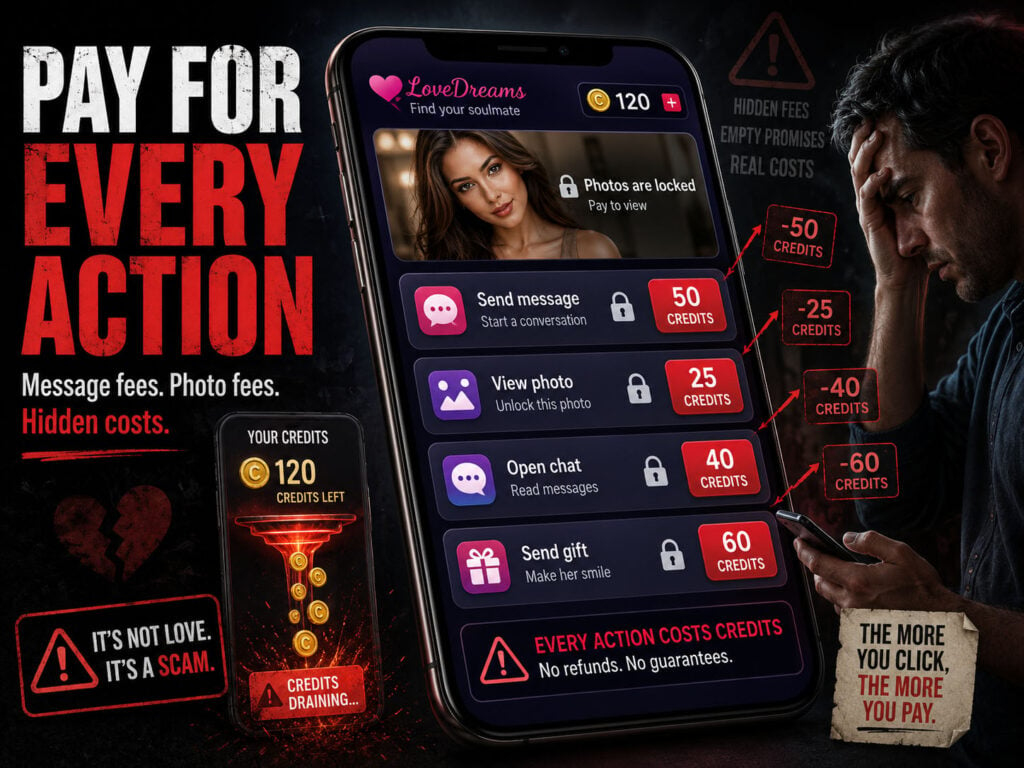
Credit systems are not always bad. But you should understand exactly what each credit buys before you start clicking.
Be wary when you need credits to send a message, open a message, view photos, send a gift, read replies or continue a conversation that was started by someone else. The total can climb much faster than a straightforward monthly subscription.
Check the real cost of a typical conversation, not just the cheapest credit bundle on the pricing page.
6. The Pricing Is Framed to Look Cheaper Than It Is
“Only 41 cents a day” sounds harmless. But that may mean you are being billed for several months upfront, enrolled in automatic renewal or pushed toward a package that is far more expensive than it first appears.
Before you pay, check:
- the total charged today
- whether the payment renews automatically
- how often it renews
- how to cancel
- whether unused credits expire
- whether refunds are available
If the total price is hard to find or you have to dig through multiple screens to understand it, treat that as a warning sign.
7. The “Guarantee” Has Impossible Fine Print
Some dating sites advertise guarantees, free extensions or refunds if you do not find a match. Read the conditions before you treat that as real protection.
A guarantee is worthless if it requires you to send dozens of messages, meet narrow activity targets, keep a perfect record of your actions and claim the offer during a tiny window at the end of your subscription.
Good consumer protection is simple. If the guarantee needs a legal degree to understand, assume it may be designed to look better in an advert than it works in practice.
8. Cancelling Looks Harder Than Joining
A legitimate service should make it reasonably clear how to cancel recurring billing.
Warning signs include vague cancellation instructions, support-only cancellation, international phone numbers, endless menus, repeated “special offers” when you try to leave, or unclear wording about whether deleting your account actually stops billing.
Before you subscribe, find the cancellation policy first. If you cannot clearly work out how to leave, do not give the site your card details.
9. The Site Pushes You to Pay Before You Can Verify Anything
Some platforms make it almost impossible to judge whether the user base is real before paying. You may receive messages but be unable to read them, see profiles but be unable to contact anyone, or be shown blurred photos and teaser notifications designed to create urgency.
That is not proof of a scam by itself. But it is a poor sign when the whole experience is engineered around pressure rather than helping you make an informed decision.
A decent dating service should give you enough information to decide whether it suits you before it starts extracting money.
Profile-Level Warning Signs
These signs are about the individual person you are speaking to. This is where romance scams, catfishing, extortion and fake verification links tend to appear.
10. They Want to Leave the App Immediately
Moving to WhatsApp, Telegram, Signal or text is not automatically suspicious. Plenty of real people do it.
It becomes a concern when they push you off the platform within a few messages, especially before you have established basic trust or verified who they are.
Scammers often want to move off the app because dating platforms can ban suspicious accounts and because private messaging gives them more control over the conversation.
11. They Will Not Video Call or Meet
Everybody has their own comfort level. Nobody owes you a date or a video call on demand.
But repeated excuses over weeks or months are different. A person who is supposedly deeply interested in you but will never do a short live video call, never send a normal spontaneous photo and never make a realistic plan to meet is a major concern.
Do not keep paying for a fantasy relationship with somebody who cannot verify they are the person in their profile photos.
12. The Relationship Moves Ridiculously Fast
Love bombing is when someone overwhelms you with affection, compliments, future plans and emotional intensity before there is any real foundation.
They may call you their soulmate after a few days, talk about moving in together, claim fate brought you together or tell you that nobody has ever understood them like you do.
Real attraction can happen quickly. But trust takes time. Slow the pace down when someone is trying to create emotional commitment before you have even met.
13. There Is Always an Emergency That Needs Money
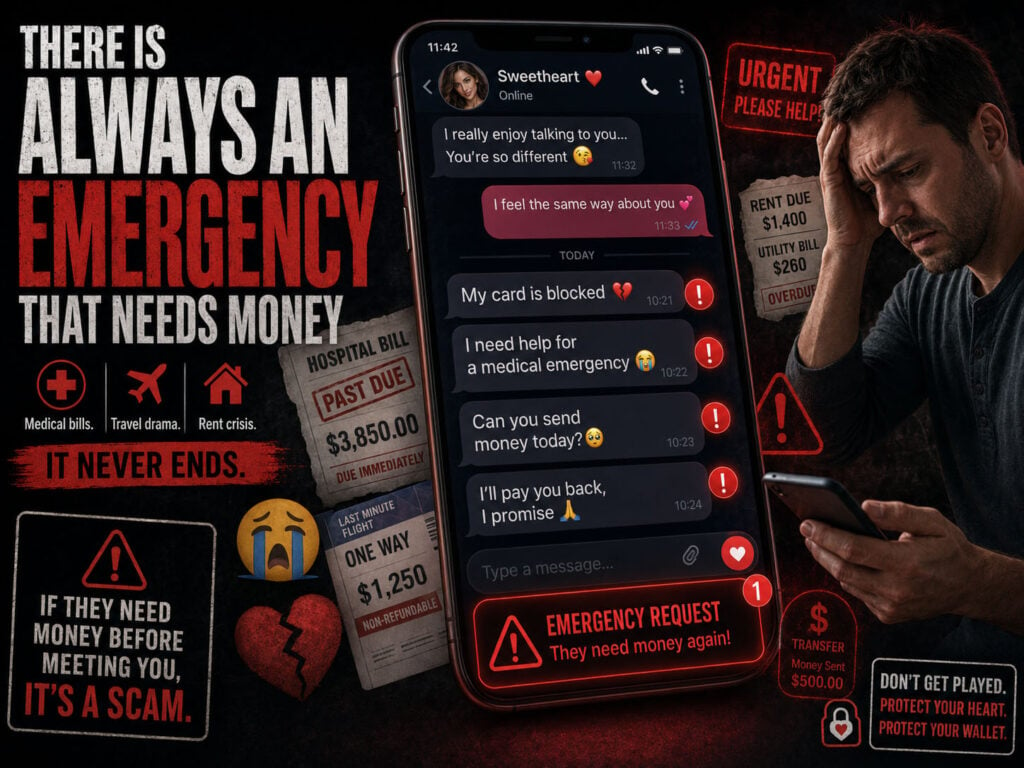
This is the clearest red flag in the entire article.
Medical bills. A family crisis. A broken-down car. A lost passport. A missed flight. A customs problem. A child who needs help. The stories vary, but the destination is the same: they want money.
Do not send money, gift cards, bank transfers, cryptocurrency or “temporary help” to someone you met online and have not properly verified in real life.
14. They Want to Teach You About Crypto or Investing
This is one of the most damaging modern romance scams.
The person builds trust, appears successful and eventually introduces a “safe” crypto, forex or investment opportunity. They may show screenshots of profits, guide you through deposits and encourage you to invest more once you see fake gains.
The platform is often controlled by the scammer. You may be able to deposit money easily but find it impossible to withdraw.
Do not take investment advice from somebody you met through a dating app. Ever.
15. Their Profile Is Too Perfect but Weirdly Empty
Attractive people exist. Great photos are not proof of fraud.
The concern is the combination: model-quality images, a vague bio, no real details, no normal social footprint, no friends, no hobbies, no location context and no answer when you ask simple questions about their life.
Run a reverse image search when something feels off. It takes two minutes and can save you a lot of grief.
16. They Are Always Abroad, Deployed or “Just About to Visit”
Long-distance dating can be real. People travel for work. Military personnel exist. None of that is suspicious on its own.
It becomes a problem when being abroad is used as a permanent excuse for why they cannot meet, cannot video call properly or need money for a flight, visa, hotel, customs charge or medical emergency.
Do not fund someone’s travel to meet you. A real adult who wants to see you can organise their own journey.
17. Their Messages Feel Scripted or Their Story Keeps Changing
Scammers and chat operators often work from scripts. You may notice generic answers, questions that ignore what you just said, strange wording, repeated pet names or sudden contradictions about their job, location, family or age.
One typo proves nothing. People write quickly, use translation tools and make mistakes.
But when the conversation repeatedly feels like it could be happening with anyone, trust your instincts. Ask normal, specific follow-up questions and see whether the answers make sense.
18. They Send You a “Verification” Link
A match may claim they need you to verify your age, identity or safety before meeting. They then send you to a third-party site that asks for a card number, personal details or a login.
Do not use links sent by strangers to verify yourself. They may be designed to take payment, collect your details or infect your device.
If a dating platform has a real verification process, it should be handled inside the platform itself, not through a random external website sent in a chat.
19. They Try to Get Explicit Photos or Video Quickly
Sextortion scams often begin with flattering conversation, sexual pressure and requests for intimate photos or webcam activity.
Once the scammer has something compromising, they may threaten to send it to your friends, family, employer or social-media contacts unless you pay.
Never send intimate material to someone you have not properly verified. If somebody threatens you, do not negotiate or keep paying. Save the evidence, block them and report it to the platform and relevant authorities.
20. They Insist on One Specific Bar or Club for a First Date
Be careful when a match refuses every normal meeting suggestion and insists on one obscure venue you have never heard of.
There are documented scams where a date steers someone to a particular bar or club, orders aggressively and disappears once an inflated bill arrives.
For a first meeting, choose a normal public place you know: a coffee shop, central bar or casual restaurant. Do not hand over your card or passport to staff, and leave if the situation feels wrong.
21. They Ask Questions That Sound Like Security Questions
Someone you are dating may naturally ask about your childhood, family and life. That is normal.
But be cautious when the questions become unusually specific: your mother’s maiden name, first pet, school name, childhood street, bank details, passport information or answers that could be used to reset accounts.
Do not share sensitive information with someone you have not met and verified. Romance scams are not always just about getting a quick payment. Sometimes the goal is identity theft.
What to Do Before You Pay for a Dating Site
Before you buy a subscription or credits, do five things:
- Read the Terms of Service for virtual-profile, entertainment and operator disclosures.
- Check exactly what you are paying for and whether billing renews automatically.
- Search the company name alongside words like “reviews,” “complaints,” “refund” and “cancel subscription.”
- Use a payment method with proper consumer protections, not cryptocurrency or bank transfer.
- Never send money to a person you met online, no matter how convincing their story is.
The Bottom Line
The danger is not just outright fraud. Some dating sites are technically operating within their terms while still being a terrible deal for somebody who thinks they are paying to meet real people.
Read the small print. Understand whether you are buying a dating service, a credit-based chat experience or access to a platform where the most active profiles may not be available to meet in real life.
And when it comes to individual matches: slow things down, verify people properly, never send money and do not let loneliness override common sense.